
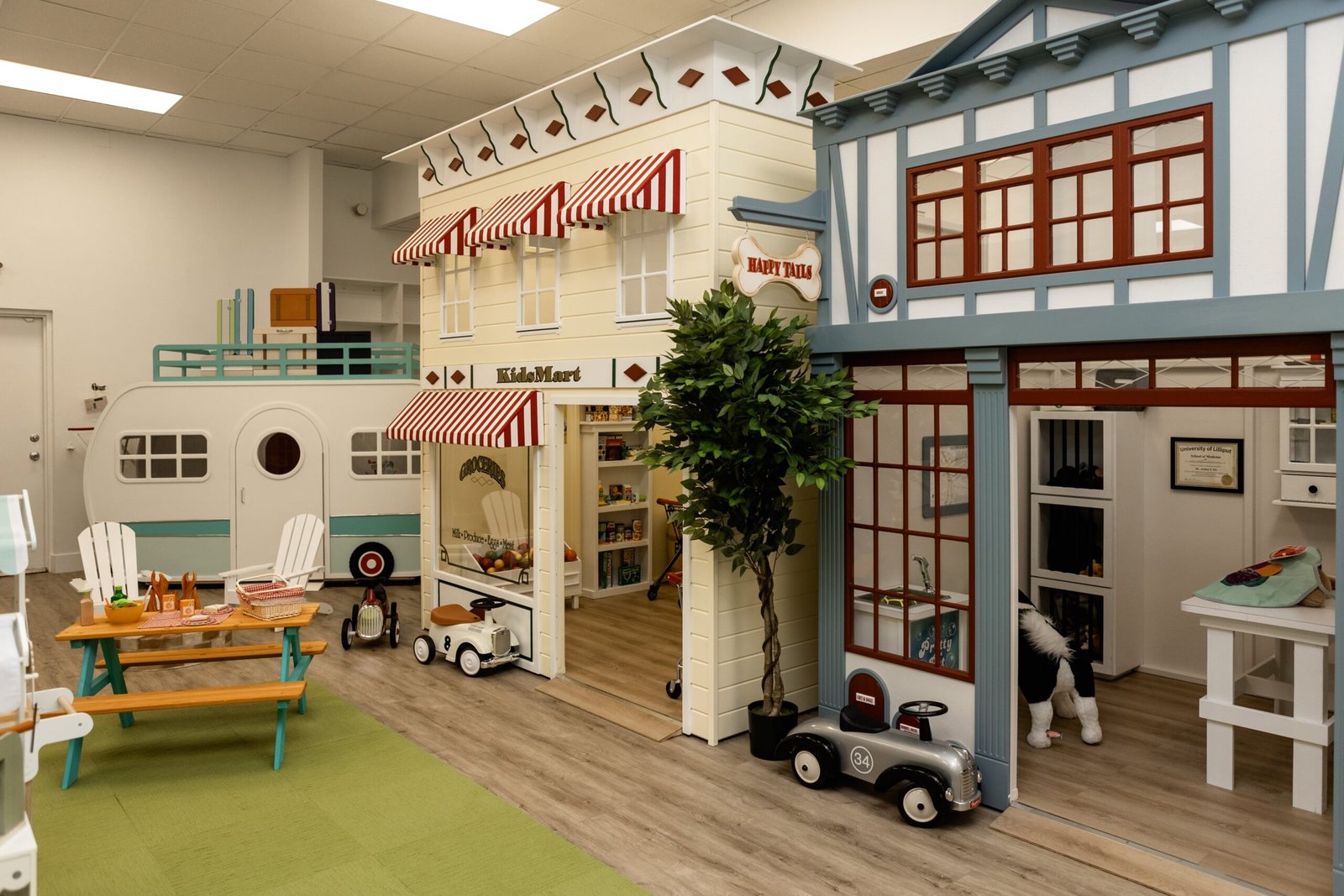
If you’ve been searching for an indoor playground for kids near me in the Fort Lauderdale area, you’re not alone. Thousands of South Florida parents are looking for safe, engaging, and developmentally rich spaces where their little ones can play, explore, and grow — especially during those long, hot summer months or unpredictable rainy afternoons.
But not all indoor play spaces are created equal. Some are massive warehouses designed for older kids with towering climbing structures and flashing arcade games. Others are little more than a bouncy house in a strip mall. What parents of toddlers and preschoolers really need is something different: a thoughtfully designed space that meets young children exactly where they are developmentally.
That’s where open play sessions at a pretend-play indoor playground come in — and it’s exactly what we’ve built at Kids Hideout in Fort Lauderdale. Our space is designed specifically for children ages 0 to 8, with imaginative play stations like a mini grocery store, veterinary clinic, fire station, and beauty salon that spark creativity and build real-world skills through play.
Whether you have a curious 18-month-old who’s just starting to explore or a social 5-year-old who loves role-playing with friends, open play sessions offer something structured classes and screen time simply can’t replicate. Here are five research-backed benefits that keep Fort Lauderdale families coming back week after week.
1. Social Development: Learning to Share, Cooperate, and Communicate
One of the most powerful benefits of open play at an indoor playground is how naturally it builds social skills in young children. When toddlers and preschoolers play alongside — and eventually with — other kids their age, they practice essential skills like turn-taking, sharing, negotiating, and reading social cues.
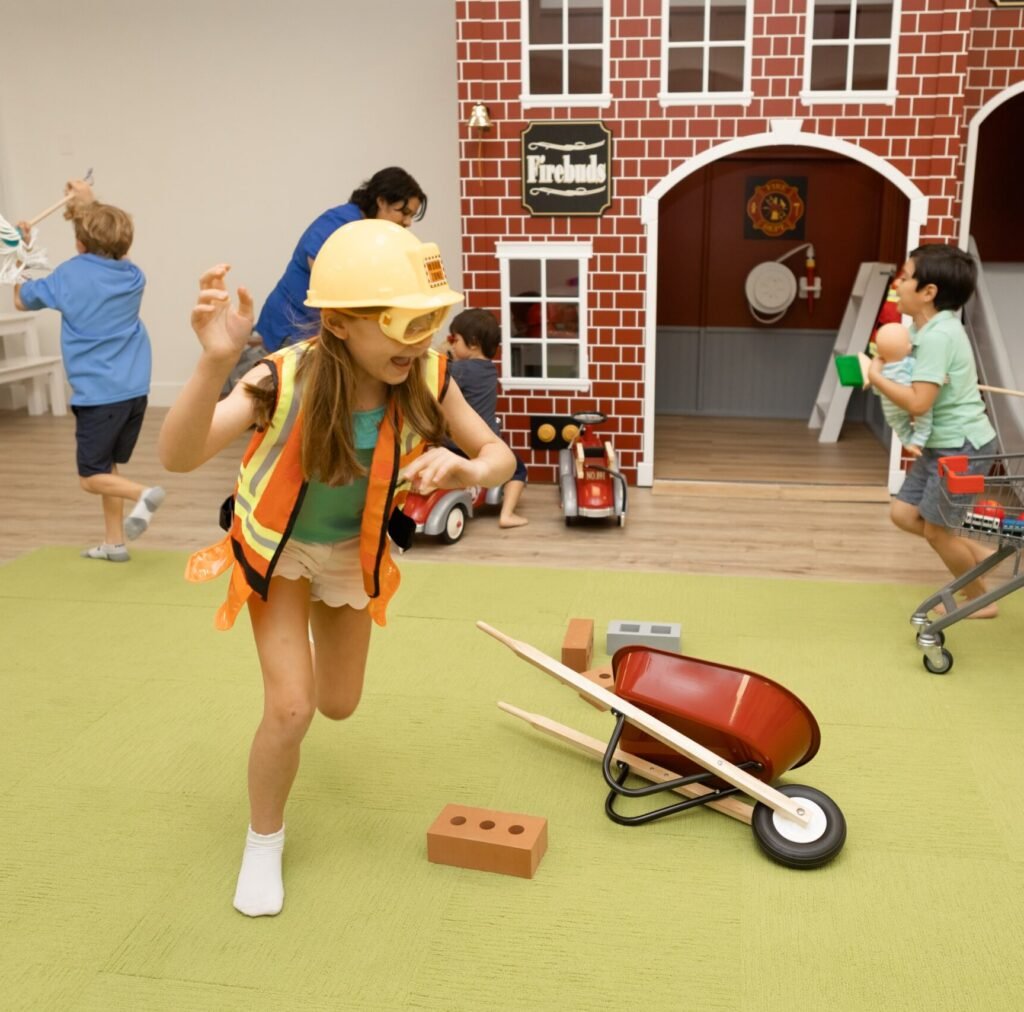
The American Academy of Pediatrics (AAP) emphasizes that unstructured play with peers is one of the most effective ways for children to develop social-emotional competence. In a clinical report on the power of play, the AAP notes that free play helps children learn to work in groups, resolve conflicts, and practice self-advocacy — skills that become the foundation for success in school and beyond.
For Kids Ages 1-3 (Toddlers)
If you’re looking for an indoor playground for kids 1-3, you’ll notice that toddlers at this stage engage in what developmental psychologists call “parallel play” — playing beside other children rather than directly with them. This might look like two toddlers both pushing toy shopping carts through our pretend grocery store without interacting. But don’t let the lack of conversation fool you. During parallel play, toddlers are absorbing an enormous amount of social information: how other children move, what facial expressions mean, and how to exist in a shared space. It’s the earliest form of social learning, and it lays the groundwork for cooperative play later on.
For Kids Ages 3-6 (Preschoolers)
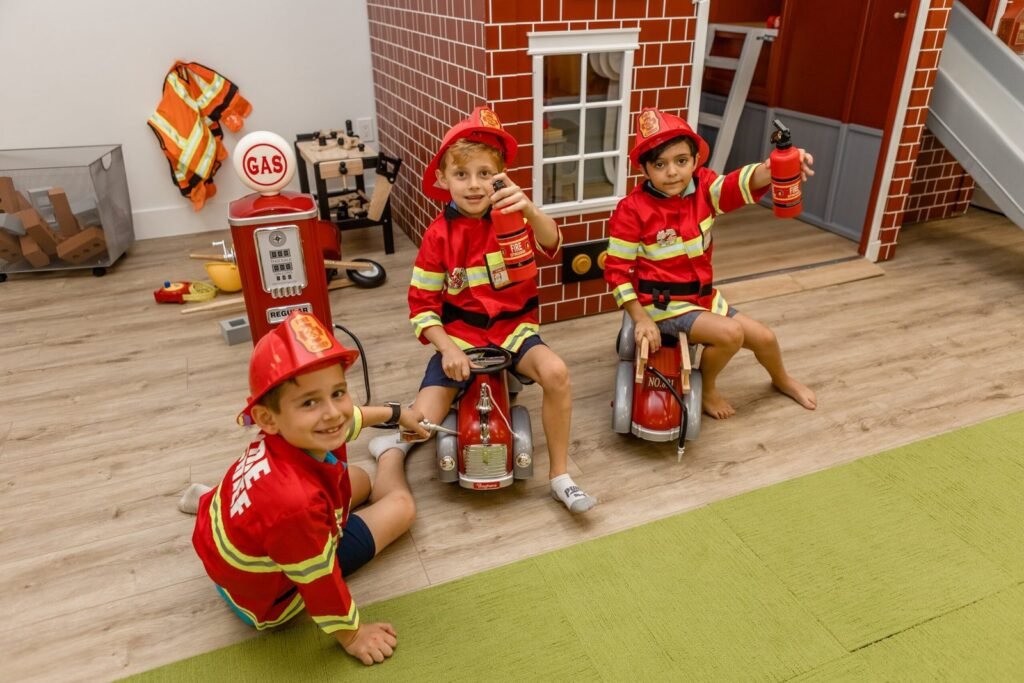
For families seeking an indoor playground for kids 3-6, open play becomes a social goldmine. Preschoolers transition into associative and cooperative play, where they actively engage with each other — assigning roles at the play kitchen, collaborating to “put out a fire” at the fire station, or deciding who gets to be the veterinarian and who brings in the stuffed-animal patient. According to the National Association for the Education of Young Children (NAEYC), this kind of social pretend play is directly linked to stronger language skills, emotional regulation, and the ability to understand other people’s perspectives.
At Kids Hideout, our play stations are intentionally designed to encourage these interactions. There’s no screen to stare at in isolation — just imaginative worlds that are more fun when you share them with someone else.
2. Physical Development: Active Bodies in a Safe Space
Are Indoor Playgrounds Safe for Toddlers?
This is one of the most common questions parents ask — and it’s a great one. Yes, indoor playgrounds designed for young children are safe for toddlers, and in many ways they’re safer than outdoor alternatives. A well-designed indoor play space eliminates risks like vehicle traffic, sharp landscaping, extreme heat, and unpredictable surfaces while still giving kids the physical challenges they need.
The CDC’s developmental milestones guidelines highlight that children ages 1 to 5 need regular opportunities to practice gross motor skills — walking, climbing, balancing, reaching, and carrying. Open play at an indoor playground provides all of these in a padded, climate-controlled, age-appropriate environment.
At Kids Hideout, every element of our space is scaled for small bodies. Shelves are at toddler height. Play stations are designed so children can reach, manipulate, and move through them independently. There are no towering climbing walls or equipment built for 12-year-olds. The entire facility is built so that a 2-year-old can navigate it with confidence and a parent can see their child from virtually anywhere in the room.
Beyond gross motor skills, open play also strengthens fine motor development. Picking up play food, pressing buttons on a toy cash register, dressing up in costume accessories, stacking blocks — these small, repetitive movements build hand-eye coordination and dexterity that children will need for writing, drawing, and self-care tasks like buttoning a shirt.
Explore our play space and see how it’s designed for active, safe play: Visit our Open Play page.
3. Cognitive Growth Through Pretend Play
Here’s where Kids Hideout’s approach to indoor play really stands apart. While many playgrounds focus on physical structures — slides, ball pits, trampolines — our space is centered on pretend play, also known as dramatic play or imaginative play. And the research behind it is compelling.
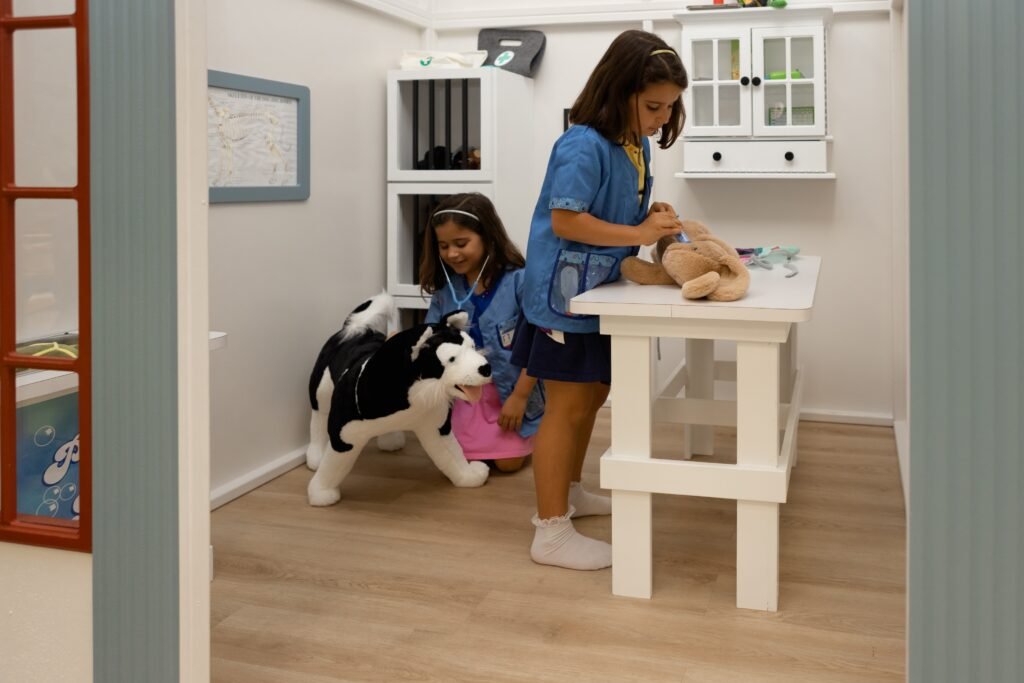
The Harvard Center on the Developing Child has published extensively on how imaginative play builds executive function skills — the mental processes that allow children to plan, focus attention, remember instructions, and juggle multiple tasks. When a 4-year-old pretends to be a doctor treating a stuffed animal, they’re holding a scenario in working memory, following a sequence of steps, and inhibiting the impulse to break character. These are the same cognitive skills that predict academic success later in life.
The NAEYC reinforces this, noting that pretend play is one of the most powerful vehicles for developing abstract thinking in young children. When a child picks up a wooden block and calls it a phone, they’re demonstrating symbolic thought — the ability to let one thing represent another. This is the same cognitive leap that underlies reading (letters representing sounds) and math (numerals representing quantities).
At Kids Hideout, every play station is designed to spark this kind of thinking:
- Grocery store: Children “shop” with carts, scan items, and practice counting at the register — building early numeracy and sequencing skills.
- Veterinary clinic: Kids examine stuffed-animal patients, use pretend medical tools, and practice caregiving — developing empathy and vocabulary.
- Fire station: Children dress up, respond to imaginary emergencies, and collaborate on rescue missions — strengthening narrative thinking and teamwork.
- Beauty salon: Young stylists practice fine motor skills with brushes and accessories while engaging in social conversation with their “clients.”
This isn’t just play for the sake of play. It’s the kind of deep, immersive, child-led experience that builds the neural pathways children will need for learning, problem-solving, and creativity. Take a look at our themed play areas in the Kids Hideout Gallery.
4. Sensory Stimulation in a Controlled Environment
Young children learn about the world primarily through their senses. Touch, sight, sound, and movement are how toddlers and preschoolers process new information, and sensory-rich environments are essential for healthy brain development.
An indoor playground designed for young kids offers a carefully curated sensory experience that balances stimulation with comfort:
- Tactile play: Different textures in play food, costumes, building materials, and interactive elements encourage children to explore with their hands.
- Visual stimulation: Bright, themed environments with recognizable real-world settings (a kitchen, a clinic, a store) help children make connections between play and life.
- Auditory engagement: The natural sounds of children playing, laughing, and narrating their pretend scenarios create a rich auditory landscape that supports language development.
- Proprioceptive input: Carrying play items, pushing carts, reaching for objects on shelves — these weight-bearing and movement activities help children develop body awareness and spatial orientation.
For South Florida families, an indoor play environment offers a major practical advantage as well. Fort Lauderdale summers regularly hit the mid-90s with stifling humidity, and the rainy season (June through October) makes outdoor play unreliable at best. An air-conditioned indoor playground gives children all the sensory stimulation they need without the risks of heat exhaustion, sunburn, or sudden thunderstorms. It’s one of the reasons so many Fort Lauderdale parents search for an indoor playground for kids near me as a go-to activity — especially between May and October.
5. Parent-Child Bonding: Quality Time Without Screens
In a world where screens compete for every moment of attention — yours and your child’s — open play sessions offer something increasingly rare: uninterrupted, device-free quality time together.
At Kids Hideout, parents stay in the play space with their children. There’s no drop-off. No separate viewing area behind glass. You’re right there — playing store with your toddler, helping your preschooler “cook” dinner in the play kitchen, or simply sitting nearby and watching them navigate a new social interaction on their own.
Research from the AAP consistently shows that the quality of parent-child interaction matters far more than the quantity of toys, classes, or activities a child has access to. When parents engage in their child’s play — following the child’s lead, narrating what’s happening, asking open-ended questions — they strengthen the attachment bond and support language development simultaneously.
Open play makes this easy because there’s no agenda. You don’t need to keep up with an instructor’s pace or worry about your child falling behind in a class. You just follow their curiosity. If your 2-year-old wants to spend 45 minutes at the grocery store station, you spend 45 minutes at the grocery store station. That kind of screen-free, child-led time is one of the most valuable gifts you can give a developing brain.
And honestly? It’s a gift for parents too. There’s something deeply restorative about watching your child light up in a space that was built just for them — no highway noise, no sunscreen reapplication, no fighting over the iPad. Just play.
Open Play vs. Structured Classes: Which Is Right for Your Child?
Many parents wonder whether open play or structured classes are a better fit for their child. The truth is, both have value — and many families end up doing both. Here’s how they compare:
| Feature | Open Play | Structured Classes |
|---|---|---|
| Schedule | Drop-in during posted hours | Fixed day and time each week |
| Structure | Child-led, unstructured | Instructor-led, curriculum-based |
| Reservation | No reservation needed | Pre-registration required |
| Social Interaction | Organic, peer-driven | Guided by instructor |
| Best For | Exploration, creativity, flexibility | Specific skill-building (music, dance, language) |
| Parent Involvement | Parent stays and plays alongside | Varies by class format |
| Age Suitability | All ages 0-8 | Typically grouped by age |
| Commitment | None — come when it works for you | Weekly or multi-week enrollment |
| Cost | Per-visit or play pass | Per class or semester |
At Kids Hideout, we offer both open play sessions and structured classes and events like Zumbini and Mommy & Me, so you can mix and match based on your child’s needs and your family’s schedule.
What Age Is Appropriate for an Indoor Playground?
This is one of the most frequently asked questions we hear from parents, and the answer depends entirely on the space. Large-scale entertainment centers with tall climbing structures, loud music, and older kids running at full speed can be overwhelming and even unsafe for toddlers. But a boutique indoor playground designed for young children is a completely different experience.
At Kids Hideout, we welcome children from birth through age 8. Babies under 12 months play for free, and our space is specifically scaled so that crawlers, new walkers, confident toddlers, and preschoolers can all play safely and independently. There are no massive structures to get stuck on. No older kids barreling through. Every element is built for small hands and small bodies.
If your child can sit up and reach for objects, they’re ready for open play at a space like ours. The key is choosing an indoor playground that’s designed for your child’s age group — not one that lumps toddlers in with ten-year-olds.
How Much Does Indoor Playground Open Play Cost?
Indoor playground pricing in the Fort Lauderdale area varies widely. Most venues charge between $12 and $25 per child for an open play session, with some larger entertainment centers charging more for all-day passes that include attractions designed for older kids.
At Kids Hideout, a single open play visit is $17 per child and includes admission for up to two accompanying adults. Babies under 12 months are always free. For families who visit regularly, our Play Pass multi-visit packages bring the per-visit cost down significantly — a 10-visit pass brings each session to just $14 per child.
Compared to alternatives like trampoline parks, bounce house centers, or children’s museums in Broward County, open play at a pretend-play indoor playground offers exceptional value — especially when you consider the developmental benefits and the fact that there’s no time limit on your visit. Check current pricing and hours here.
Why Parents in Fort Lauderdale Choose Kids Hideout
Fort Lauderdale has no shortage of kids’ activities, but families keep coming back to Kids Hideout for a few specific reasons:

- Pretend-play focus: Unlike generic bounce houses or climbing gyms, our entire space is built around imaginative play — the kind of play that research shows builds the strongest cognitive and social foundations.
- Designed for ages 0-8: No big kids, no overwhelming structures. Every square foot is built to scale for toddlers and preschoolers.
- Clean and safe: We maintain rigorous cleaning protocols and our space is designed with clear sightlines so parents can supervise comfortably.
- Air-conditioned comfort: South Florida parents know the struggle of outdoor play in 95-degree heat. Our fully climate-controlled space means your kids get all the activity they need without the sweat and sunburn.
- Private party rooms: When it’s time to celebrate, our dedicated party rooms offer a seamless experience — your child and their guests get the best of both worlds with play time and a private celebration space.
- Classes and events: Beyond open play, we offer music classes, Zumbini, and special events that complement your child’s play experience.
- Field trips welcome: We also host field trips for schools and daycares looking for enriching, age-appropriate outings.
Frequently Asked Questions About Open Play at an Indoor Playground
Are indoor playgrounds safe for toddlers?
Yes. Indoor playgrounds that are specifically designed for young children — like Kids Hideout — use age-appropriate equipment, padded surfaces, and clear sightlines to create a safe environment. Unlike outdoor playgrounds or large entertainment centers built for all ages, a boutique indoor playground scaled for toddlers eliminates many common safety concerns including extreme weather, traffic, and oversized equipment.
What age is appropriate for an indoor playground?
It depends on the facility. Large-scale entertainment centers may not be suitable for children under 3. However, indoor playgrounds designed specifically for young children welcome babies as young as a few months old. At Kids Hideout, we cater to children ages 0 through 8, and babies under 12 months play for free.
How much does open play cost at an indoor playground?
In the Fort Lauderdale area, open play sessions typically range from $12 to $25 per child. At Kids Hideout, admission is $17 per child and includes up to two adults. We also offer Play Pass multi-visit packages that reduce the per-visit cost — a 10-visit pass brings it down to $14 per child.
What should my child wear to an indoor playground?
Comfortable clothes they can move in freely are best. Avoid loose jewelry, scarves, or anything that could catch on play equipment. Most indoor playgrounds — including Kids Hideout — require socks for all visitors (children and adults) for hygiene reasons, so make sure to bring a pair or purchase one at the front desk.
Can I host a birthday party during open play hours?
At Kids Hideout, birthday parties are held in private party rooms separate from open play, so your group gets a dedicated celebration space along with access to the play area. This means the birthday child and their guests enjoy the full pretend-play experience while also having a private room for food, cake, and presents. Learn more about our party packages.
What is pretend play and why is it important for toddlers?
Pretend play (also called dramatic or imaginative play) is when children act out scenarios, take on roles, and use objects symbolically — like pretending a block is a phone or “cooking” a meal in a play kitchen. Research from the Harvard Center on the Developing Child and the NAEYC shows that pretend play builds executive function, language skills, social-emotional development, and abstract thinking. It’s considered one of the most important types of play for children ages 1 through 6.
Ready to Experience Open Play at Kids Hideout?
If you’re searching for the best indoor playground for kids in Fort Lauderdale — one that’s built around real developmental benefits, not just flashy attractions — we’d love to welcome your family to Kids Hideout. Our open play sessions run daily during posted hours, no reservation needed. Just show up, check in, and let your little one explore.
Check today’s Open Play hours and get your tickets here.